CE Marking on a product indicates compliance with the essential requirements for health & safety as outlined in the PPE Regulation (EU) 2016/425.
The manufacturer of CE-marked goods verifies that the product complies with all applicable EU requirements, such as safety, health and environmental protection, and if stipulated in any EU product legislation, has had them examined by a Notified Body or produced according to a certified production quality system.
Not all products need CE markings. Only product categories subject to relevant directives or regulations are required or allowed to bear CE marking. End-users of protective products should refer to PPE Regulation (EU) 2016/425 for the assessment of health and safety at work. Employers are required to carry out a risk assessment before deciding on the appropriate protective equipment for their employees.
Please contact the local safety authority in your region for additional information on CE marking.
This catalogue offers hundreds of items that are fully CE compliant. This provides total assurance of product manufacturing standards.
This International Standard specifies requirements for high visibility clothing, is capable of visually signalling the user’s presence. The high visibility clothing is intended to provide conspicuity of the wearer in any light condition when viewed by the operators of vehicles or other mechanised equipment during daylight conditions and under the illumination of headlights in the dark.
High Visibility clothing has a fluorescent surface, combined with reflective material that meets certification requirements in 3 different classes:
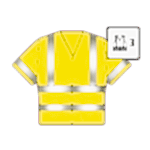 |
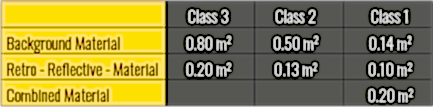
Class 3: Highest Level Highest level of protection - required for any person working on or near motorways or dual-carriageways or airports. Must incorporate a minimum of 0.80m2 of background material and 0.20m2 of retro-reflective materials. (4 metres of 5cm wide reflective tape)
|
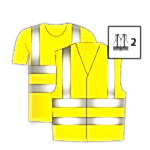 | Class 2: Intermediate Level Required for any person working on or near A and B class roads, also for delivery drivers. Must incorporate a minimum of 0.50m2 of background material and 0.13m2 of retro-reflective material. (2.60 metres of 5cm wide reflective tape)
|
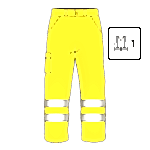 | Class 1: Minimum Level The minimum level of protection required for any person working on a private road or to be used in conjunction with a higher classed garment. Must incorporate a minimum of 0.14m2 of background material and 0.10m2 of retro-reflective material. (2 metres of 5cm wide reflective tape) 0.10m2 of retro-reflective material. (2 metres of 5cm wide reflective tape)
|
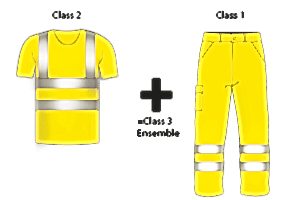 | EN ISO 20471 Class 3 Ensembles There are two ways to attain EN ISO 20471 Class 3 at Myform. Either choose an EN ISO 20471 product that is rated Class 3 on its own or choose two products that together are Class 3 certified. |
 |
EN 343 Protective clothing against rain
This standard specifies PPE Clothing used for working in rain or snow, fog and ground humidity.
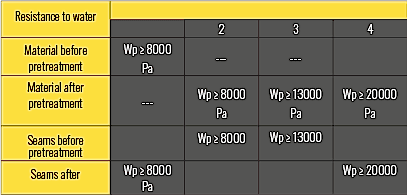
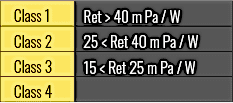
According to the latest version of the standard, EN 343:2019, the garment and seams are tested for water penetration (waterproofness) class 1-4 and water vapour resistance (breathability) class 1-4, where class 4 is the highest level. The garment must achieve a result on both tests to be CE marked with the EN 343 symbol.
The breathability of the garments are affected by its construction and it is common for an unlined garment to reach EN 343 class 4:4 (same as the outer fabric) whilst lined garments in the same outer fabric might only achieve EN 343 class 4:2 for example. In these cases it is the lining in the garment that affects the permeability of water vapour resistance (breathability). The test method of waterproofness of a readymade garment in rain tower has also been added to the standard. This test is optional.
The previous version of the standard (EN 343:2003+A1:2007) has 3 classes. The requirements of class 1-3 for resistance to water penetration are the same in both versions of EN 343, but now class 4 has higher requirements. The result for water vapour resistance (breathability) has also been expanded with a 4th class and the levels of each class are
ⓧ Resistance to water penetration
Protective clothing – Enhanced visibility equipment for medium-risk stations. – Test methods and requirements, supersedes two separate standards and brings together elements of each of the withdrawn standards:
EN 1150:1999- Protective clothing- Visibility clothing for non- Professional use – Test methods and requirements.
En13356:2001 – Visibility accessories for non- Professional use – Test methods and requirements.
All products meeting the requirements of the standards are no longer considered in terms of their use, but rather their suitability in providing protection in medium-risk situations as defined by their enhanced visibility properties.
The En 17353 standards are applicable to clothing and devices worm in medium risk situations such as working with- moving vehicles, jogging on roads with lower traffic speeds, or cycling. It sets forth the minimum amounts of materials that should be incorporated into products in order to ensure enhanced visibility on an end-user. The standard also describes the design requirements for various types of products based on the foreseeable conditions of use by Type ‘A’, ‘B’ and ‘AB’.
TYPE A
Equipment worm by users where the risk of not being seen exists only at daylight conditions. This equipment uses only the fluorescent material as an enhanced visibility component.
TYPE B
Equipment is worn by users where the risk of being seen exists only in dark conditions. This equipment uses only the retroreflective material as an enhanced visibility component. Including:
TYPE B1
Free hanging retroreflective devices.
TYPE B2
Retroreflective devices are temporarily or permanently placed on limbs only.
TYPE B3
Retroreflective material is placed on the torso or torso and limbs.
TYPE AB
Equipment is worn by users where the risk of not being seen exists during daylight, twilight, and dark conditions. This equipment uses fluorescent as well as retroreflective and/or combined performance materials as enhanced visibility components.
However, the En 17353 standards are not applicable to:
High visibility equipment in high-risk situations, which is covered in EN ISO 20471; Visibility equipment specifically intended for the head, hands, and feet, e.g. helmets, gloves, and shoes: Equipment integrating active lighting, e. g. LEDs; Visibility for low–risk situations.
All products subject to EN 17353:2020 are considered as Category II Personal Protective Equipment according to (EU) 2016/425 and require an EU Notified body to undergo a CE compliance assessment procedure in order to be marketed with the CE mark.
Protective Clothing - Heat and Flame Protective Clothing
This standard defines the performance requirements for garments designed to protect the wearer (excluding hands) from heat and/or flame. The performance requirements set forth in this international standard are applicable to garments that have limited flame propagation properties and are intended for use where the wearer may be exposed to radiant, convective or contact heat or splashes of molten metal. This test uses standard methods and conditions to predict the performance of fabrics/clothes in contact with heat or flame. In addition to the fabric, the sewing, logo and closure systems used in the dress should also be tested. Tests should be performed on pre-machined components according to the manufacturer’s care label.
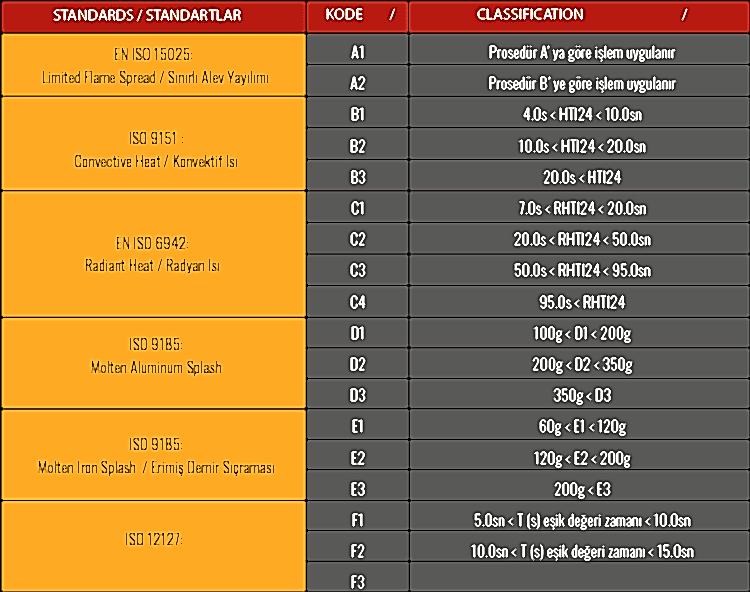
The data in the table below is taken into account for the classification of protective clothing according to the EN 11612 standard.Koruyucu elbiselerin EN 11612 standardına göre sınıflandırılması için aşağıdaki tablodaki veriler dikkate alınır.
Limited Flame Spread
Procedure A (A1) limited flame propagation testing is mandatory. It is the flame spread test from the fabric surface, it is tested with the apparatus shown below. As a result of the test performed according to Procedure A; There will be no holes in any sample, there will be no flame jumping on top or the sides in any sample, no sample will melt or drip by melting, flame extinction time average ≤2 sec., core extinction time average ≤2 seconds. and the seams have conditions that will continue to hold the fabric panels together. It is valid even though there is no flame, hole or flammable residue in the tested fabric. Procedure B (A2) testing is optional. It is the test for the spread of flame from the fabric edge. As a result of the test performed according to Procedure B; All considerations except hole formation and sewing apply.
EN 11612 B: ISO 9151 Convective Heat Transfer
Procedure B – In the optional convective heat transfer test, it is tested by holding the flame with a heat flow density of 80 kW/m2 on the clothes or parts of the dress such as the fabric and accessories. 24 °C (Celsius) degrees on the back surface of the test specimen The time taken for temperature rise is measured. At least level B1 must be achieved.
B1: 4 < 10 seconds
B2: 10 < 20 seconds
B3: 21 seconds or more
EN 11612 C: ISO 6942 Radiant Heat Transfer
Procedure C – The radiant heat transfer test is mandatory for EN 11612:2015 and optional for EN ISO 11611:2015. The test is the same for both standards, but the classification is different. It is tested by holding the flame with a heat flow density of 20 kW/m2 on the clothes or parts of the dress such as fabric and accessories. The time taken for a temperature rise of 24 °C (Celsius) on the back surface of the test specimen is measured. At least level C1 must be achieved.
C1: 7 < 20 seconds
C2: 20 < 50 seconds
C3: 50 < 95 seconds
C4: 95 seconds or more
EN 11612 D and E: ISO 9185 Molten Metal Splash
Procedures D and E - Molten Metal Splash. In the molten metal spatter test (determining levels D and E), D represents aluminium melt and E represents iron melt. The sample fabric is stretched over the PVC film in a frame in the test setup. PVC film here represents human skin, and any damage to the PVC film means that human skin will be damaged. The test measures the amount of molten metal needed to damage the PVC film.
Classification for molten aluminum:
D1: 100 < 200 grams
D2: 200 < 350 grams
D3: 350 grams and more
Classification for molten iron:
E1: 60 < 120 grams
E2: 120 < 200 grams
E3: 200 grams and more
EN 11612 F: ISO 12127 Contact Temperature
Procedure F - Contact Heat. The optional contact temperature test is the test of measuring the time taken for the temperature increase of 10 degrees Celsius on the back surface of the fabric, which is contacted with the metal plate at a temperature of 250 degrees Celsius. At least an F1 level must be achieved. The test results may vary depending on fabric weight and fibre blend.
Classification for contact heat:
F1: 5 < 10 seconds
F2: 10 < 15 seconds s
F3: 15 seconds or more
Other testing standards:
EN 14116: Covers the performance characteristics of materials used in protective clothing regarding limited flame spread.
EN 469: Protective clothing for firefighters
ISO 13934-1: Tensile strength
ISO 13937-2: Tear strength
ISO 5077: Dimensional stability
ISO 17493: Heat resistance
Protective Clothing - Protective Clothing for Welding and Related Processes
This tip is used for protection against small metals, short-term heat by flame, and radiant heat. Clothes used in this international standard and similar works (other than hand welding) use minimum basic equipment and test methods. This standard defines two classes of specific performance products.
EN ISO 116 11 removes the fronts and lower parts of protective schools, schools and their fronts. There are a number of other designs for use for purchasing droplets found anywhere on clothing. Testing is not encouraged according to the manufacturer’s care label.
In terms of necessity:
*This bookcase and not made on the seams.

Protective Clothing Electrostatic Properties
This standard is used for protection against use, not for protection under electrostatic conditions. In European standards, testing paths and specifications for clothing in protective clothing are part of the standards. This standard specifies the clothing to be worn, the clothing to be worn, and the design features. These requirements can have high lightning enrichment weather conditions. This standard is not applicable to maintenance versus use.
EN 1149 consists of:
EN 1149-1: Surface defining test method
EN 1149-2: Test method of electrical measurement of material (vertical step)
EN 1149-3: Test method for measurement of load (charge) attenuation
EN 1149-4: test (development)
EN 1149-5: Material performance and design.
Electrostatic emitter shielding may be covered as unsuitable use in normal use. Conductive parts (zippers, aids, etc.) are given by being covered by the material intended for use.
Protective Clothing - Protective Clothing Against Thermal Effect of Electric Arc
This standard specifies the requirements and test methods for protective clothing and materials used against the thermal effects of an electric arc. An electric arc is a continuous electrical discharge of a high current between conductors that produces very bright light and intense heat. The electric arc releases much more energy on the surface of the protective clothing for a short time than an open flame. Two international test methods have been developed to provide information on the resistance of clothing to the thermal effects of electric arcs. Each method gives different information. One or both must be done to comply with the standards.
Open Arc Method EN 61482-1-1
This test method aims to detect the ATPV (Arc Thermal Performance Value) or EBT (Energy break threshold) of the fabric. ATPV is the amount of energy (50% probability) required to cause a 2nd-degree burn to pass through the material before breaking. In other words, ATPV represents the maximum thermal energy load per square centimetre of a fabric that can protect the user from 2nd-degree burns. EBT is the amount of energy at which the material breaks (50% probability). This is normally the upper limit of the fabric where the material loses its mechanical resistance and the fibres are also damaged. Both ATPV and EBT are expressed in calories per cm² (cal/cm²).
Box Test Method EN 61482-1-2
The fabric/dress is exposed to an electric arc for 0.5 seconds in a box bounded by a special electrode arrangement. Class 1 - 4 kA is a current of the arc; Class 2 - 7 kA is a current of arc.
Protective Clothing Against Liquid Chemicals
Performance requirements for protective clothing provide limited protection against liquid chemicals (equipment type 6 and type PB [6]) This standard specify minimum requirements for limited use and limited reuse performance of chemical protective clothing. Limited performance chemical protective clothing, where exposure to light sprays, liquid aerosols or low pressure, low volume splashes is likely where a full liquid permeability barrier (at a molecular level) is not required. Intended for use in situations This standard covers both chemical protective clothing (Type 6) and partial body protectors (Type 6B).
Protective Clothing for Firefighters
Performance rules for protective clothing for use in firefighting. This standard is to plan minimum performance for apparel related to users used in firefighting operations and aids such as rescue work, accidents. This European Standard relates to the use and minimum performance specifications for the clothing worn in their operation. Clothing should provide systemists with complete protection, including the neck, wrists, arms and wrists. Even when you’re on the go, jackets and shopping paths should endanger your safety.
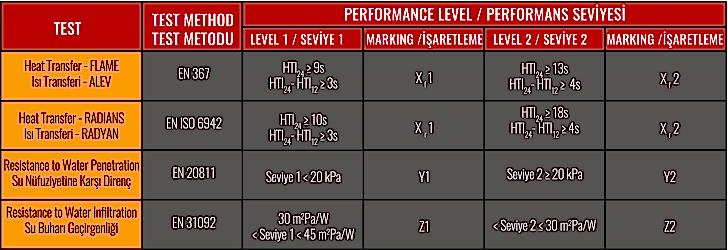
Depending on the level of protection of human clothes according to the EN 469 standard, two-level related:
Seviye 1 , Seviye 2
Level 2 garments must have a water moisture design.
Tier 2 dresses provide higher performance than Tier 1 dresses and are marked according to their performance level.
Something like “1” if the suit got a level 1 on any of the tests, even if it’s a level 2.
Regarding EN 469 benchmarking, on 4 different tests and in connection with these tests are referred to as classes 1 and level 2. Also, a dress according to these tests in the upper cabin.
Do you need help?
Write to us via Whatsapp


Download our digital catalog for MYFORM separation

Be the first to be informed about news from us, MYFORM products and special offers.

Like us on social media and stay informed about our latest news and newest products.

Click to contact us and for your information and opinions.